How to Make Money on Facebook?

Süper Fırsatlar sizin elinizde!
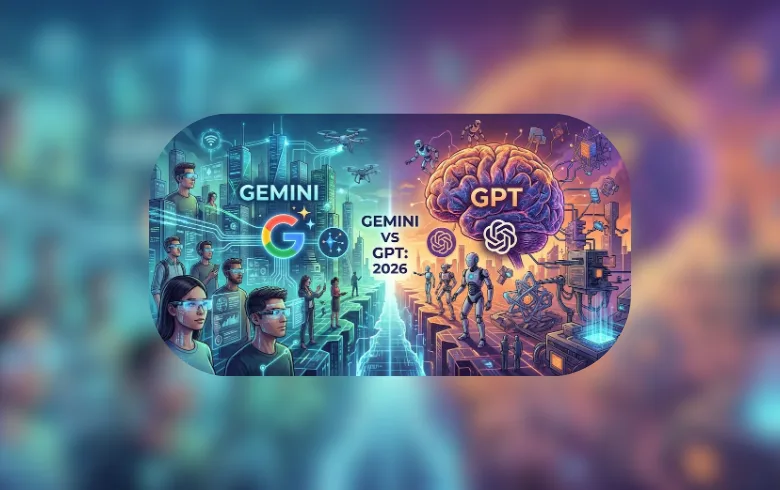
Do you remember the early days of the AI revolution back in 2023? It feels like a lifetime ago. We were all so easily impressed by a chatbot that could write a passable email or generate a slightly uncanny image of a cat playing chess. Looking back from where we stand now in 2026, those days seem almost quaint. The technology has matured at a blistering pace, moving from novel toys to the invisible infrastructure of our daily lives.
Today, AI isn't just a tab in your browser; it’s the operating system of your reality. But even as the technology has become ubiquitous, the central power struggle hasn't changed. The heavyweight championship bout is still the same, just fighting with vastly more powerful weapons. The question hanging over every enterprise CTO, creative professional, and everyday user remains: are you backing gemini or gpt in 2026?
Deciding isn't as simple as comparing benchmark scores on a chart anymore. It’s about choosing an ecosystem, a philosophy of interaction, and determining which digital nervous system you want to plug your life and work into.
To understand the choice between gemini or gpt in 2026, you have to understand how the battlefield has shifted. The era of "prompt engineering" as a highly specialized skill is mostly dead. The models are too intuitive now; they understand intent without needing to be coaxed.
Furthermore, multimodality is no longer a feature; it is the baseline requirement. If an AI model cannot simultaneously process a live video feed, analyze complex audio cues, read thousands of pages of text, and write code in real-time, it’s already obsolete. Both Google and OpenAI have achieved this, but they have applied these god-like powers in fundamentally different ways.
If 2024 was about Gemini catching up, 2026 is about Gemini weaving itself into the fabric of reality. Google’s massive advantage—its dominance in mobile OS, search data, and personal workspace apps—has finally matured into a cohesive AI experience.
Gemini's greatest strength in 2026 is its deep integration with hardware. Whether through the lens of your Android phone or the smart glasses that are finally becoming mainstream, Gemini doesn't just read text; it experiences your world in real-time.
Imagine walking into a hardware store looking for a specific replacement part. You don't type a description. You simply look at the broken part while wearing smart glasses, and Gemini whispers in your ear exactly which aisle the replacement is in, confirms it's in stock, and highlights it in your vision via augmented reality. This isn't science fiction anymore; it's Tuesday afternoon. Gemini excels because its context window isn't just tokens of text; it’s your immediate physical environment.
For professionals deeply embedded in the Google ecosystem, the choice of gemini or gpt in 2026 is practically made for them. Gemini has moved beyond drafting emails in Gmail. It now acts as a proactive executive assistant across the entire suite.
It attends your Google Meet calls, summarizes the key action items, automatically updates the relevant Sheets and Jira boards, drafts the follow-up documents in Docs, and schedules the next check-in on Calendar, all without a single explicit prompt. It anticipates needs based on project flow. Google has bet the farm on frictionless utility, making Gemini the path of least resistance for enterprise productivity.
While Google focused on integration, OpenAI, bolstered by massive computing partnerships, doubled down on raw cognitive horsepower and autonomy. In 2026, the GPT iteration (let's call it GPT-5.5 or 6) is the undisputed king of complex reasoning and independent agency.
This is the biggest differentiator when debating gemini or gpt in 2026. OpenAI has aggressively pursued the "agentic" future. You no longer just chat with GPT; you assign it a job.
You might tell GPT, "Plan a two-week marketing campaign for our new product launch, targeting Gen Z on TikTok and Instagram, with a budget of $50,000. Create the assets, schedule the posts, and set up the ad buys."
In 2026, GPT doesn't just give you a to-do list. It actually spins up autonomous agents to do the work. It interfaces with design tools to generate visuals, writes the copy, logs into ad platforms via secure APIs to set up the campaigns, and then monitors performance, adjusting bids in real-time. You become the manager, reviewing its work, rather than the operator doing the tasks.
While Gemini is incredibly functional, GPT maintains an edge in abstract creativity and nuanced reasoning. When you need an AI to help brainstorm a novel's plot structure, debug a particularly nasty piece of quantum computing simulation code, or engage in deep philosophical debate, GPT’s responses feel richer and less constrained.
It feels less like a super-efficient secretary and more like a brilliant, sometimes unpredictable, collaborator. For industries requiring deep innovation and generative capabilities—gaming, high-level coding, advanced research—GPT remains the preferred engine room.
So, how do you actually choose? It comes down to what you value most: seamless integration into your existing life or raw, autonomous power.
Here is a quick breakdown of how the two titans stack up in the 2026 landscape:
| Feature | Google Gemini | OpenAI GPT |
| Primary Strength | Ecosystem Integration & Real-time Utility | Deep Reasoning & Autonomous Agents |
| Multimodality | Best for real-world, live visual analysis via hardware. | Best for generating complex multimodal media assets. |
| Interaction Style | Proactive assistance, "always on" background layer. | Task-oriented delegation, managing teams of AI agents. |
| Best Use Case | Managing daily life, corporate productivity, real-time information. | Complex problem solving, creative generation, executing multi-step projects. |
| Privacy Vibe | The "Big Tech" trade-off: high utility for massive data access. | The "Black Box" trade-off: incredible power but sometimes opaque processes. |
"The mistake people make is thinking there will be one winner. In 2026, we don't have one internet; we have different biomes. You choose the AI that rules your biome."
The debate over gemini or gpt in 2026 is no longer about which model is "smarter." They are both terrifyingly smart. They both pass virtually every human benchmark test we used back in the early 2020s.
The choice is now about utility and workflow.
If your life revolves around an Android phone, Google Workspace, and you want an AI that proactively smooths the friction of your daily existence by seeing what you see and knowing what you know, Gemini is the obvious choice. It is the ultimate co-pilot for reality.
If your work requires deep, abstract thought, heavy coding, or you want to leverage autonomous agents to execute complex projects while you sleep, the GPT ecosystem provides raw power that Google’s safer, more curated approach can't quite match.
Ultimately, many of us in 2026 find ourselves using both. We use Gemini to manage our schedule and navigate the physical world, and we fire up a GPT agent to handle the heavy mental lifting of our complex projects. The future isn't about picking a single winner; it's about knowing which god to pray to for which miracle.
Our most popular services on social media

Enter your order code!

If you experience delivery issues with your guaranteed orders, you can quickly request a replacement.


A single post can touch thousands of hearts.
Log in to your account now and start enjoying the benefits.
Not a member? Sign Up